
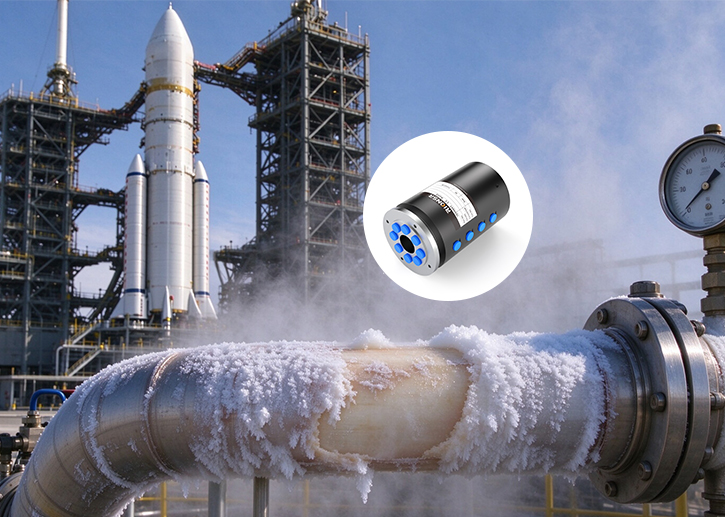
Manufactured per special specifications for aerospace propellant pipelines, RIONSR through-bore cryogenic rotary unions are engineered for 360° rotating filling arms transferring -253℃~-183℃ liquid hydrogen & liquid oxygen. Solving critical launch pad safety pain points including cryogenic seal embrittlement, vacuum heat preservation, hose tangling and micro leakage, they are fully deployed on launch vehicle ground refueling systems.
Before lift-off, rockets receive continuous cryogenic propellant via ground rotary pipelines. Filling arms rotate omnidirectionally to align vehicle ports under extreme medium temperature and alternating diurnal temperature, wind & dust at launch sites. Conventional fluid union seals crack under -200℃ ultra-low temperature, creating severe detonation risks from micro propellant leakage. Non-through-bore designs force external hose routing, leading to fatigue fracture during arm rotation. Ordinary housing lacks double vacuum insulation and accelerates medium vaporization with high propellant waste. Narrow single passages slow filling flow and risk missing launch windows. Standard seals fail after repeated thermal cycles, requiring repeated pipeline inspection before every rocket mission.
RIONSR cryogenic unions feature full central through-hole for main propellant lines without external hoses. Modified perfluoroether FFKM special sealing material sustains long -253℃ liquid hydrogen immersion without embrittlement. Double vacuum insulated housing drastically cuts vapor loss, rated working pressure 3.5 MPa matching standard aerospace filling specifications. Independent dual inlet & outlet large-flow passages shorten refueling duration. Multi-stage wind & dust barriers resist launch-site grit. Rated low speed 0–45 RPM for slow arm alignment. Every unit passes hundreds of thermal cycle and cryogenic pressure leakage tests with channel leakage far below aerospace safety thresholds.
After full cryogenic union retrofit at a major space launch site, all cryogenic leakage hazards were eliminated, propellant vapor waste reduced by 79%, and single-vehicle filling time cut by 18 minutes. Pre-launch pipeline inspection frequency dropped sharply, greatly improving launch window guarantee capacity.
This hollow cryogenic rotary union also fits ground fuel storage pipelines for deep-space probes. Addressing three core launch pad demands of ultra-low-temperature sealing, vacuum heat insulation and tangle-free central routing, it delivers safe and high-efficiency operation of rocket refueling systems.