
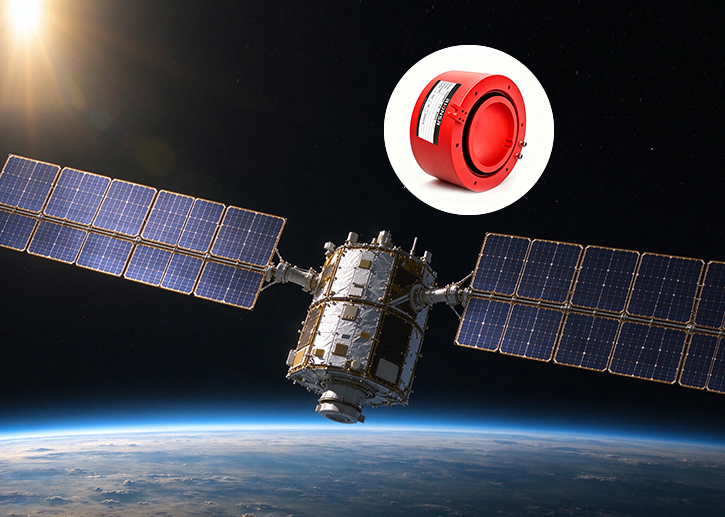
Developed per spacecraft orbital environmental standards, RIONSR high-current radiation-resistant slip rings are engineered for 360° sun-tracking rotation of satellite solar wings. Synchronously transmitting high-power charging current, attitude control bus and weak temperature sensor signals, they solve core orbital pain points including high vacuum, 100℃ day-night temperature swing, cosmic radiation and decade-long maintenance-free operation, mass deployed on low, medium and high orbit remote sensing & communication satellite array drive systems.
Satellites operate under 10⁻⁶Pa high vacuum with orbital temperature cycling from -60℃ to +125℃. Solar panels rotate daily to track sunlight with zero ground maintenance access over ten years. Conventional industrial high-current slip rings carry fatal orbital incompatibility risks: ordinary plastic insulation releases massive outgassing under vacuum and contaminates optical payloads. Standard copper tracks oxidize under cosmic radiation, steadily raising contact resistance and cutting array charging power. Low-temperature plating peels off under thermal cycles, causing intermittent power supply. Conventional seals cannot block micrometeoroid dust and trigger contact jamming, unbalancing full satellite power and disabling payloads.
RIONSR satellite slip rings adopt low-outgassing ceramic internal insulation with TML<1%, CVCM<0.1% complying with space material standards. Thick radiation-hardened gold alloy rotor tracks support 45A per circuit without plating peeling under long -60~125℃ thermal cycling. Free of organic rubber, the unit uses metal bellows vacuum isolation to resist space dust and radiation. Physically separated power, bus and temperature tracks eliminate EMI from high array current. Configurable with 6–24 high-power circuits plus multi-channel communication & temperature loops, rated low speed 0–30 RPM and 10-year maintenance-free orbital service life. Every unit passes full space simulation tests including vacuum thermal cycling, radiation and millions of rotary cycles before delivery.
After mass integration on a communication satellite series, solar power decay and attitude signal drift failures were completely eliminated. No in-orbit array maintenance is required over the full 10-year mission, greatly improving stable power generation and communication reliability while cutting orbital operation risks.
This high-temperature high-current slip ring also fits deep-space probes and space station solar steering mechanisms. Addressing three core orbital demands of vacuum radiation resistance, extreme thermal cycling and decade-long maintenance-free high-power transmission, it guarantees stable long-duration power supply for space vehicles.