
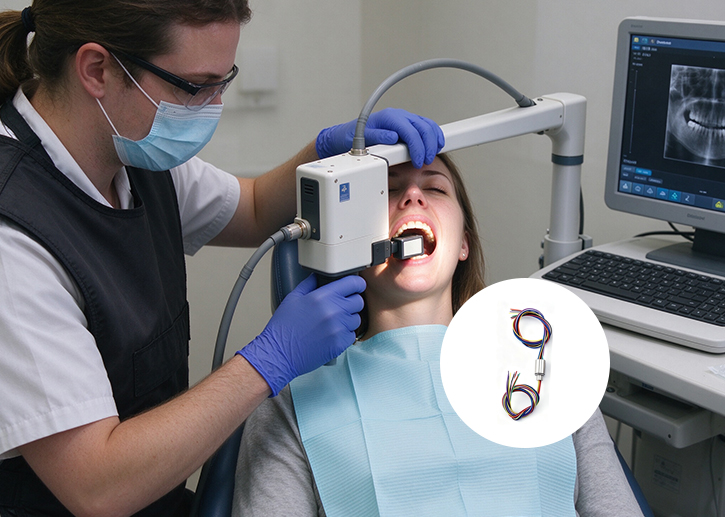
Designed under miniaturized, low-noise and sterile standards for dental equipment, RIONSR miniature capsule slip rings are engineered for 360° orbital rotary heads of dental panoramic scanners. Solving pain points of narrow head installation space, weak image signal transmission and corrosion from frequent disinfection, they are widely equipped on panoramic imaging devices in private dental clinics and hospital stomatology departments.
Rotary heads of dental panoramic X-ray machines orbit patients’ jaws in full 360° low-speed rotation, transmitting low-voltage X-ray tube power, CCD oral image signals and angle sensor feedback simultaneously. Conventional miniature conductive parts feature bulky dimensions that cannot fit compact rotary heads. Thin plating on cheap slip rings oxidizes rapidly after repeated alcohol disinfection, triggering contact resistance drift and blurry double-exposure X-ray images. Excessive rotational torque creates servo jitter, deviating shooting paths and missing edge details on panoramic films. Unsealed low-grade housing allows dental mist and disinfectant spray to penetrate contacts, cutting off signals and causing frequent shutdowns that delay patient visits. Mercury-containing liquid conductive products are prohibited in medical environments due to contamination risks and cannot be adopted.
RIONSR mercury-free miniature capsule slip rings adopt precious metal contact structure with outer dimensions matching narrow panoramic head cavities, integrating 4–18 low-voltage & image circuits per unit. Dynamic contact resistance stays within 0.01Ω, and ultra-low torque ensures smooth head rotation. Special medical disinfectant-resistant engineering plastic housing reaches IP51 dust & moisture rating to withstand daily alcohol wiping dozens of times. Rated speed 0–120 RPM fits slow jaw orbital scanning, with operating noise below 58dB for quiet clinical environments. Every unit passes millions of reciprocating rotation and disinfectant immersion durability tests, rated service life of 500 million rotations to support high-frequency daily dental radiography.
After mass replacement at chain dental clinics, blurry image and head jitter faults dropped by 90%, drastically cutting monthly equipment maintenance shutdowns. Slip ring replacement intervals extended from 2 months to 24 months, slashing clinic imaging equipment maintenance cost and shortening patient waiting time for radiography.
This miniature capsule slip ring also fits rotary heads of dental CBCT and portable X-ray devices. Addressing three core dental equipment requirements of compact head layout, disinfection corrosion resistance and quiet stable scanning, it delivers consistent clear panoramic oral images.