
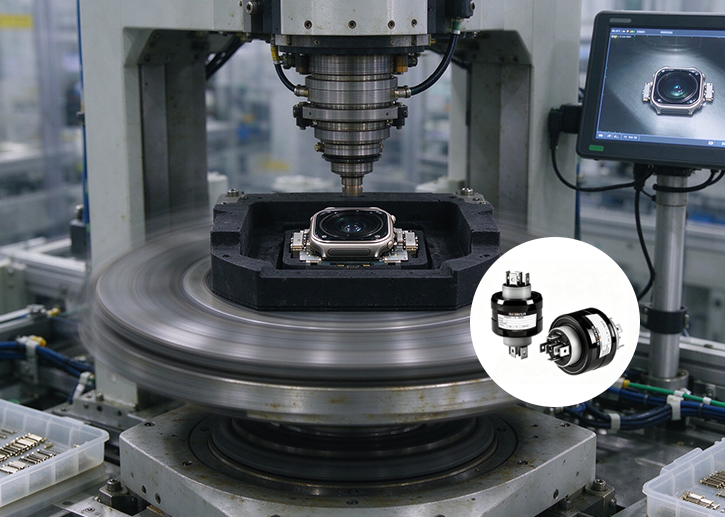
Developed in compliance with electrical specifications for precision electronic testing equipment, RIONSR mercury slip rings are engineered for high-speed 360° reciprocating aging turntables of camera modules, widely deployed on automatic testing lines for mobile phone and tablet cameras. They solve core production pain points including image signal stuttering, tiny signal distortion and limited installation space on miniature equipment.
Camera module aging testers rotate lens assemblies forward and backward at high speed non-stop, transmitting HD image signals, auto-focus control signals and 24V low-voltage power simultaneously, with hundreds of thousands of rotation cycles per unit daily. Conventional precious metal slip rings generate large contact friction, leading to severe contact resistance fluctuation above 300 RPM, horizontal image noise and drifting focus data. Standard miniature conductive parts feature bulky dimensions that cannot fit narrow tester cavities. Ordinary brushes wear rapidly under frequent high-speed rotation, cutting off signals within 2 months and breaking test data records, resulting inaccurate yield statistics. Excessive torque of generic slip rings increases servo load, raises power consumption and restricts testing cycle speed.
RIONSR mercury slip rings adopt liquid metal conductive medium without solid brush friction, stabilizing dynamic contact resistance within 0.005Ω and supporting continuous rotation up to 600 RPM. Mini cylindrical outer dimensions match narrow built-in tester cavities, with each unit integrating 4–18 low-voltage & image circuits for single and dual camera module testing. Ultra-low rotational torque avoids extra servo burden. Free of wearable solid components, the rated service life reaches 60 million reciprocating rotations to support 24/7 non-stop aging tests. IP51 dust resistance blocks fine plastic workshop dust from conductive chambers. Every unit passes millions of continuous high-speed durability cycles without image distortion failures.
After full replacement at a leading South China camera manufacturer, image interference and data drift failures dropped by 95%, extending slip ring replacement intervals from 2 months to 20 months. Testing cycle speed rose by 18%, enabling an extra 12,000 module aging tests per line daily and drastically reducing false reject rate. All optimization data are sourced from 9 consecutive months of workshop production logs.
This mercury high-speed slip ring also fits rotary test fixtures for micro sensors and watch lenses. Addressing three core pain points of high-speed rotation, weak image signal transmission and compact installation space for 3C miniature equipment, it delivers stable high-efficiency operation for automatic camera module aging testing lines.