
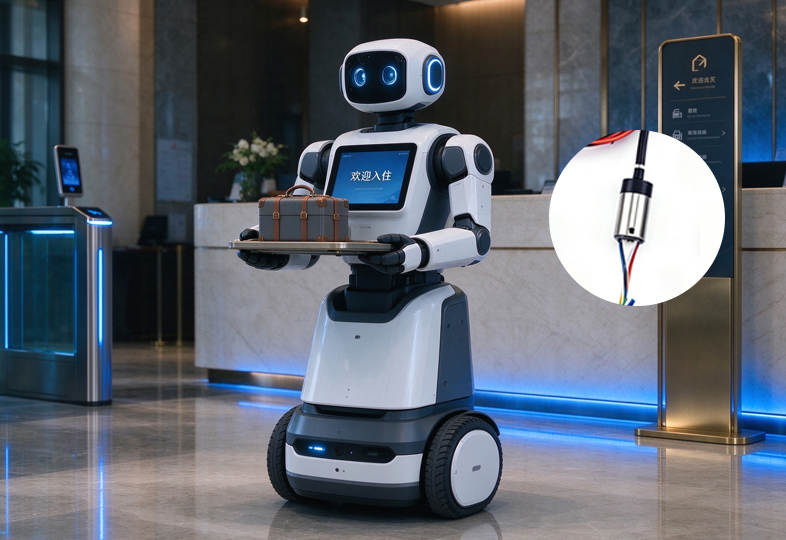
Nowadays, humanoid service robots are widely deployed in shopping malls, hotel receptions and nursing homes. The robot heads perform full 360°horizontal rotation plus vertical pitch movement, built with binocular cameras, voice microphones and touch screens, while the neck joints feature extremely compact limited internal space. Early flexible cable solutions crack within two months under thousands of daily head rotations, causing black camera screens and sudden vision loss. Robots have to stop customer service for maintenance, hurting business reception and piling up after-sales repair tickets for manufacturers.
Generic standard slip rings carry obvious drawbacks for humanoid robots: bulky size fails to fit slim neck cavities; only electric circuits available, requiring separate external air hoses if equipped with mini pneumatic cleaning nozzles or bionic air blowing modules, leading to tangled pipelines during rotation. Ordinary metal contacts generate obvious friction noise, ruining customer experience during reception. Excessive rotational torque increases servo power consumption and shortens robot battery life by 1–2 hours. Cheap thin plating contacts accumulate static and indoor dust, creating constant video noise and broken voice audio during human-machine interaction.
RIONSR customized miniature pneumatic-electric slip rings for humanoid robot heads feature ultra-small outer dimensions perfectly matching narrow neck cavities without modifying robot molds. Fully separated internal gas and passages transmit 0.4 MPa bionic blowing air while delivering 24V low voltage, gigabit vision signals and voice sensors simultaneously. One single component replaces separate slip rings and pneumatic joints to eliminate messy tangled wires, supporting unlimited 360° reciprocating rotation.
Multi-layer micro precious metal contacts produce operation noise below 55 dB for quiet customer interaction. Ultra-low torque avoids extra servo load and preserves robot battery endurance. Steady dynamic contact resistance guarantees consistent video and audio signals free of noise or audio cut-off under long-term indoor dust exposure. Customizable configurations include 2 air channels plus 12–24 signal circuits, compatible with compact household care robots and large mall guide humanoids. IP51 dust-proof housing blocks floating dust and skin debris from contacts. Every unit passes millions of reciprocating head rotation durability tests with 20-month service life between replacements.
This miniature integrated slip ring also fits rotary wrist modules of humanoid robots, solving common mass-production pain points including narrow joint space, frequent head rotation, unstable audio-visual signals and tangled bionic air pipelines for service humanoid equipment.