1 Application Overview
Rotary heating furnaces, thermal treatment spindles, automated thermal machinery and rotary material test benches require real-time temperature collection of rotating components, which mostly relies on thermocouples and RTD sensors. Temperature signals are transmitted to stationary controllers via slip rings across rotary and stationary interfaces. Conventional slip rings introduce parasitic thermoelectric potential and variable contact resistance, leading to severe temperature drift, where measurement error may even exceed actual temperature variation. Based on the Seebeck effect, this article explains thermocouple working theory, classification, cold junction compensation and design rules for slip ring temperature measurement systems.
2 Fundamental Thermocouple Working Principle
Thermocouples operate on the Seebeck thermoelectric effect. A closed loop formed by two dissimilar metal conductors generates thermoelectromotive force (EMF) when a temperature difference exists between two junctions. The EMF value correlates with temperature difference for temperature conversion.
Core advantages:
- Direct contact with measured workpieces delivers high accuracy without medium interference;
- Wide measuring range: standard types cover -50℃ ~ 1600℃, special tungsten-rhenium thermocouples reach 2800℃, gold-iron types work down to -269℃;
- Compact construction with flexible wires and protective sleeves, fitting narrow rotary installation spaces.
3 Thermocouple Classification & Standard Types
Thermocouples are split into standardized and non-standardized types by international specifications:
- Standard Thermocouples: Compliant with IEC standards, including Type S, B, E, K, R, J, T. Uniform thermoelectric curves, tolerance and reference tables match universal industrial temperature controllers, widely adopted on rotary equipment;
- Non-standard Thermocouples: Without unified calibration data, only applied for ultra-high temperature or severe corrosive special conditions.
- Four structural requirements for stable operation: firm welding of hot junctions, full insulation between two electrodes to prevent short circuit, reliable connection of extension wires, and outer protective sleeves isolating corrosive media.
4 Cold Junction Compensation Rules
The measuring hot junction sits on rotary equipment, while the free cold junction connects to stationary instruments. Precious metal thermocouples cost high, so matching extension wires with identical thermoelectric characteristics extend cold junctions to temperature-stable control cabinets.
Critical reminders: Extension wires only lengthen electrodes and cannot eliminate errors caused by fluctuating cold junction temperature; instrument cold junction compensation algorithms are mandatory. Positive and negative poles must be wired correctly, and the connection point temperature shall not exceed 100℃. Excess temperature creates extra parasitic potential and amplifies measurement error through slip rings.
5 Slip Ring Selection for Thermocouple Signals
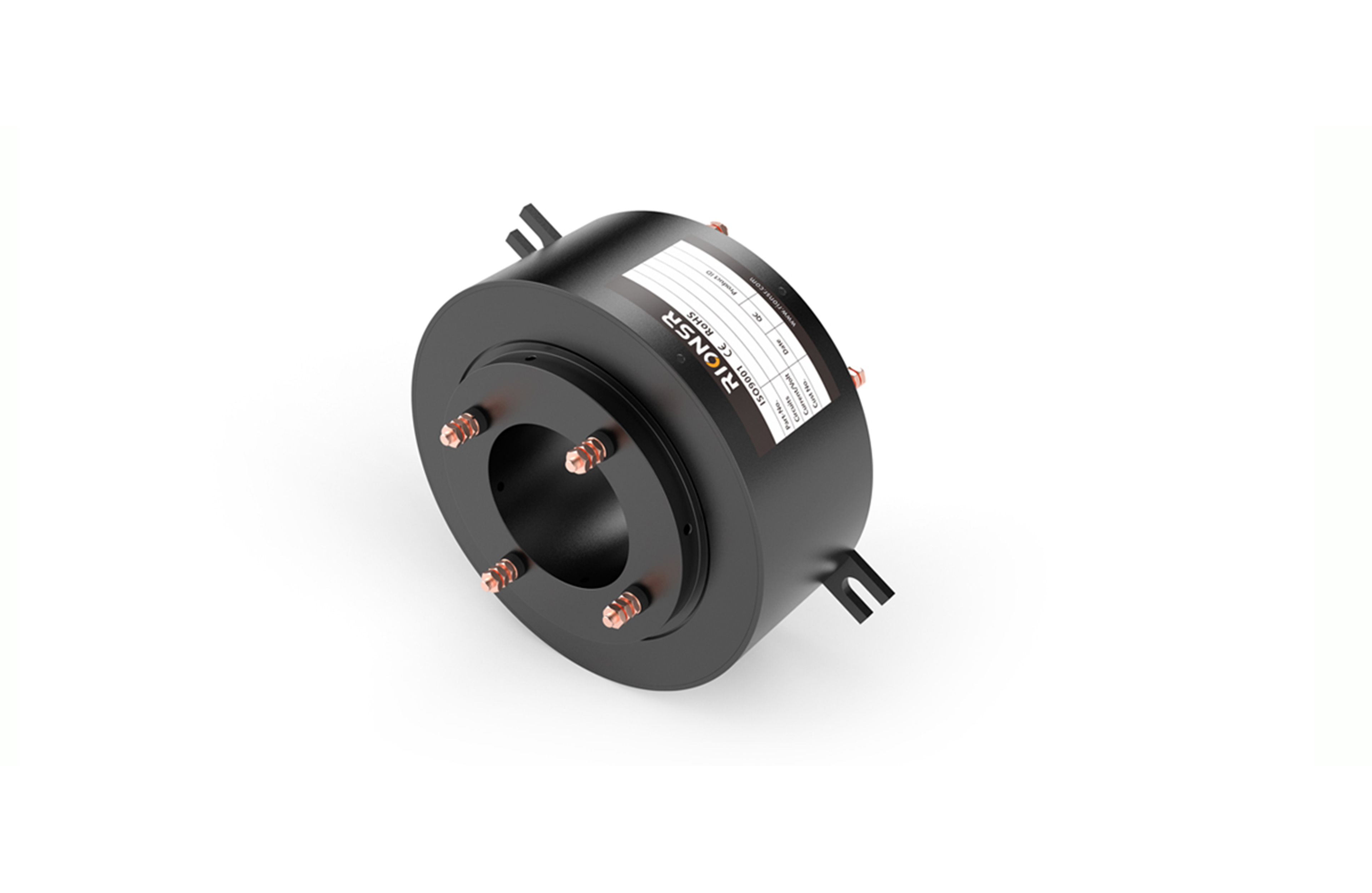
Thermocouples output tiny millivolt-level signals. Two strict indicators must be met for matched slip rings:
Ultra-low and stable dynamic contact resistance to suppress potential drift from rotational friction;
Same-series precious metal contacts per channel to cut parasitic thermoelectric potential generated by dissimilar metal contact.
Ordinary copper-contact slip rings form extra thermal voltage at rotary-stationary interfaces, causing severe distortion of final temperature readings.
Conclusion
A complete rotary temperature measuring system consists of thermocouples, extension compensation wires, precision signal slip rings and temperature controllers. Mastering the Seebeck effect, standard thermocouple grades and cold junction compensation rules, plus selecting dedicated low-resistance low-parasitic-potential slip rings, minimizes temperature drift and guarantees accurate, stable thermal data under continuous rotation.