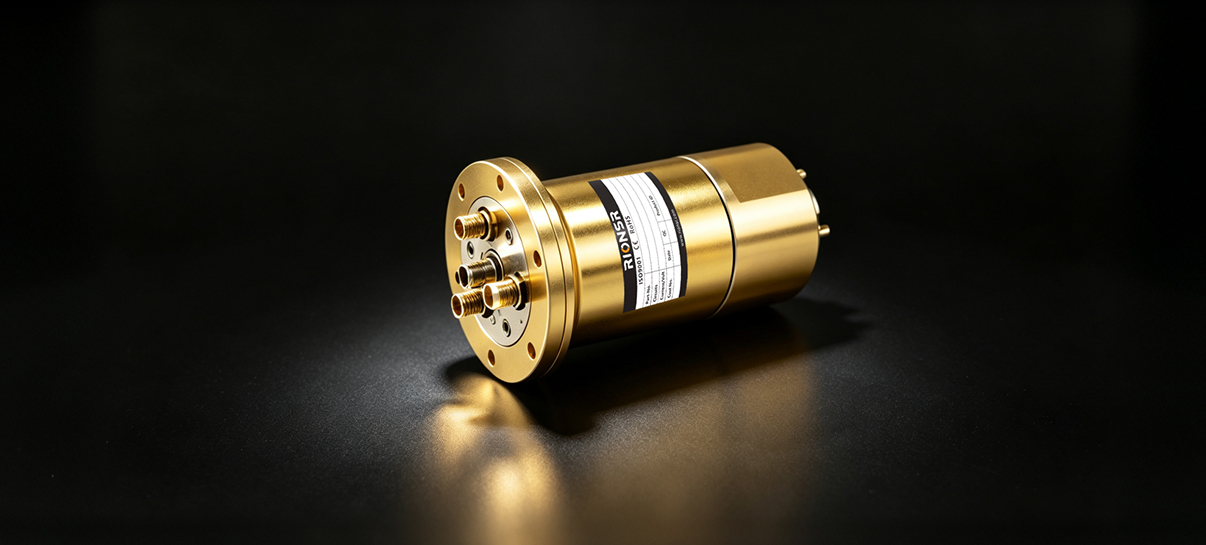
Radar antennas, RF test turrets, satellite tracking gimbals, MRI medical scanners and wireless signal analyzers require continuous 360° rotation while transmitting RF signals. Generic standard slip rings fail to maintain standard 50Ω RF impedance, triggering severe standing waves, signal reflection and excessive insertion loss, leading to inaccurate radar ranging and unstable communication links. RF high frequency slip rings (also known as rotary RF joints) adopt precision coaxial coupling architecture with factory-calibrated 50Ω impedance, covering DC to 40GHz frequency bands as an indispensable core component for all rotary RF systems. This article elaborates on working principles, critical electrical parameters, selection standards, shielding installation protocols and troubleshooting for common RF transmission failures.
RF High Frequency Slip Rings
Selection, Troubleshooting & Maintenance
1 Definition & Working Principle
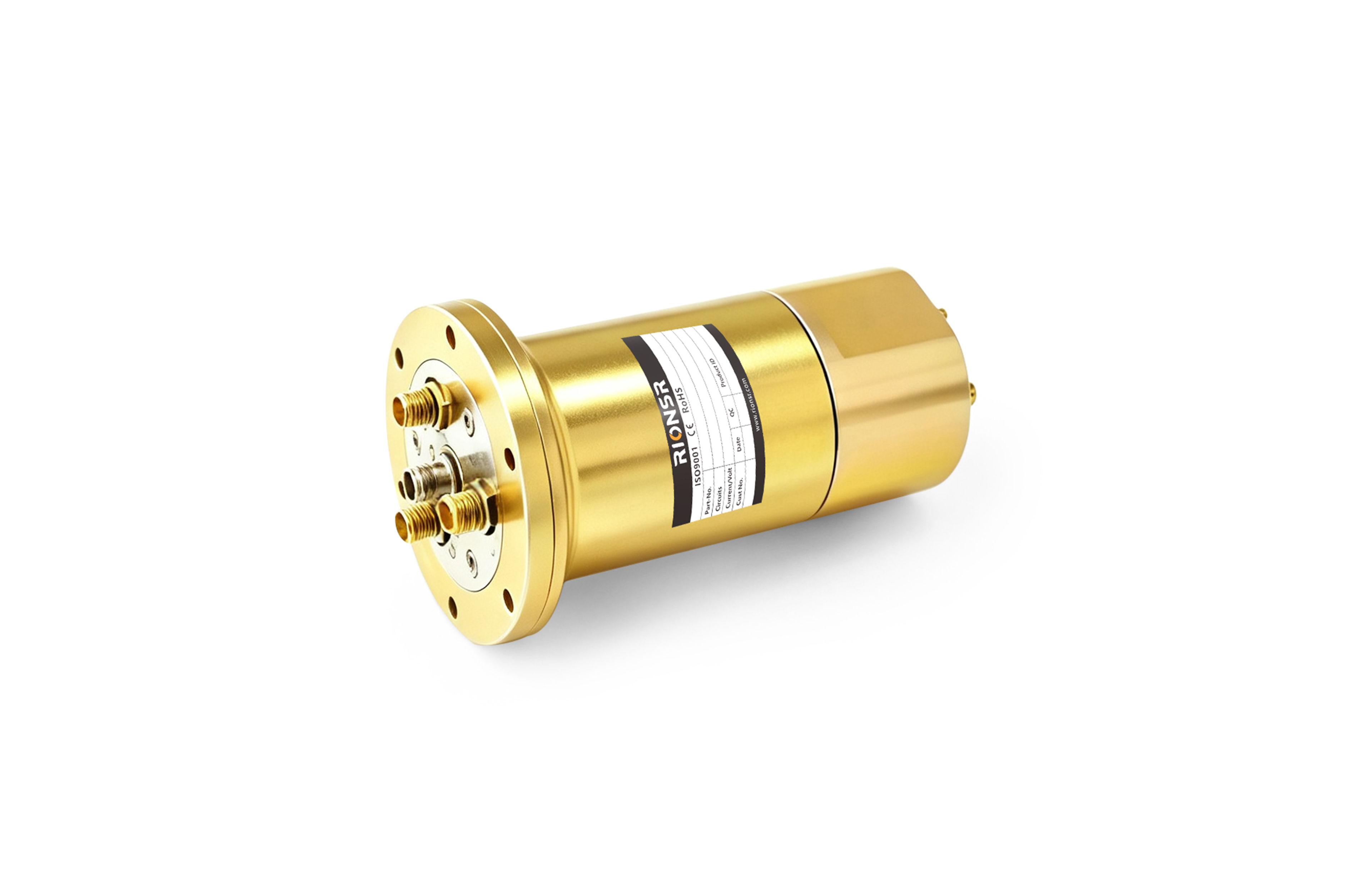
RF high frequency slip rings, or rotary RF joints, are engineered exclusively for coaxial RF signal transmission. Instead of traditional brush ring tracks, internal precision coaxial coupling cavities are deployed to maintain consistent 50Ω standard impedance across stator and rotor assemblies. RF signals propagate through electromagnetic coupling within sealed cavities during rotation, eliminating physical contact friction and delivering stable VSWR (Voltage Standing Wave Ratio) with minimal insertion loss. Three main product categories are available: single-channel RF units, multi-channel isolated RF assemblies, and hybrid RF+power integrated slip rings to meet frequency demands of radar, communication and RF testing equipment.
2.Internal Construction & Core Technical Advantages
A standard RF slip ring consists of precision coaxial coupling cavities, fully shielded metallic housing, zero-backlash bearings, sealed insulating isolation layers and industry-standard SMA/BNC RF connectors. Its specialized design resolves five dominant pain points of RF equipment manufacturers:
- Constant 50Ω Impedance Matching: VSWR maintained ≤1.2 throughout full rotation to eliminate RF standing wave reflection, guaranteeing precise radar ranging and stable transceiver performance;
- Ultra-Low Insertion Loss: Consistent attenuation across full frequency bands; millimeter-wave variants deliver loss below 0.5dB for long-distance RF power transmission without signal degradation;
- High Channel Isolation: Independent shielded cavities for each RF channel with inter-channel isolation ≥60dB, preventing cross-talk during simultaneous multi-channel RF operation;
- Wide Frequency Coverage: Standard units support DC~6GHz; customized military millimeter-wave models extend coverage up to DC~40GHz, compatible with 2G/4G/5G cellular and radar millimeter bands;
- Low Torque & Extended Lifespan: Friction-free electromagnetic coupling maintains consistent electrical performance over tens of millions of rotations, suitable for 24/7 all-weather radar tracking turrets.
3 Primary Application Sectors
- Military Communications: Airborne radar, coastal surveillance radar, satellite signal tracking gimbals, missile guidance rotary platforms;
- RF Testing: 5G base station RF test turrets, anechoic chamber antenna rotary testing rigs, wireless module signal analyzers;
- Medical Equipment: MRI rotary coils, RF ablation therapy turrets;
- Aerospace & Aviation: Satellite ground receiving rotary antennas, UAV RF communication pods;
- Industrial Inspection: RF non-destructive flaw detection equipment, microwave heating rotary workstations.
4 Critical Selection Parameters for RF Slip Rings
- Operating Frequency Band: Deploy standard variants for frequencies below 6GHz; high-precision millimeter-wave slip rings for 20–40GHz applications;
- VSWR Specification: Radar & communication systems require VSWR ≤1.2; general industrial testing equipment may accept VSWR ≤1.5;
- Channel Configuration: Single-channel base RF units, multi-channel isolated RF assemblies, hybrid integrated RF+power slip rings;
- Connector Interface: Standard SMA, BNC or 2.92mm millimeter-wave RF connectors to match customer system coaxial cabling;
- Rotational Speed & Environmental Rating: IP67 waterproof sealed enclosures for outdoor radar systems; customized high-speed bearing assemblies for fast tracking turrets; military wide-temperature housing for extreme hot/cold operating environments.
5 Shielding & Installation Standards
- Fully torque down RF cable connectors; loose fittings directly spike VSWR and drastically increase signal attenuation;
- Implement single-point full grounding of slip ring housing to suppress external electromagnetic radiation interference;
- Separate RF channels and power supply wiring with a minimum 10cm gap to avoid power harmonic cross-interference with RF signals;
- Install external metallic shielding covers for outdoor radar slip rings to block ambient stray radio waves;
- Avoid sharp bending of RF coaxial cables during assembly; strictly follow factory minimum bending radius specifications.
6 Common RF Slip Ring Malfunctions & Resolutions
- Inaccurate radar ranging & unstable signal fluctuation: Excessive VSWR caused by loose connectors or internal cavity misalignment; retorque all RF connectors and recalibrate coaxial cavity alignment;
- Cross-talk between multi RF channels: Damaged channel shielding; upgrade to multi-channel fully isolated RF slip rings;
- Severe high-frequency power attenuation: Aged RF cabling or mismatched frequency band slip ring; replace with band-matched customized RF units;
- RF signal dropout under low-temperature operation: Upgrade to military wide-temperature RF slip rings and install low-temperature heating jackets.
7 Operation & Maintenance Precautions
Never disassemble precision internal coaxial cavities independently; avoid deployment in unprotected acid/alkali or salt-spray environments; conduct annual VSWR and insertion loss performance testing; fully shock-proof all millimeter-wave models during transportation, as heavy vibration triggers permanent coaxial cavity offset.
RIONSR provides custom single & multi-channel RF high frequency slip rings covering DC~40GHz, with integrated RF, power and control signal layouts. Our low-VSWR, low-attenuation rotary RF transmission solutions are engineered for radar, 5G RF testing and satellite communication rotary equipment.