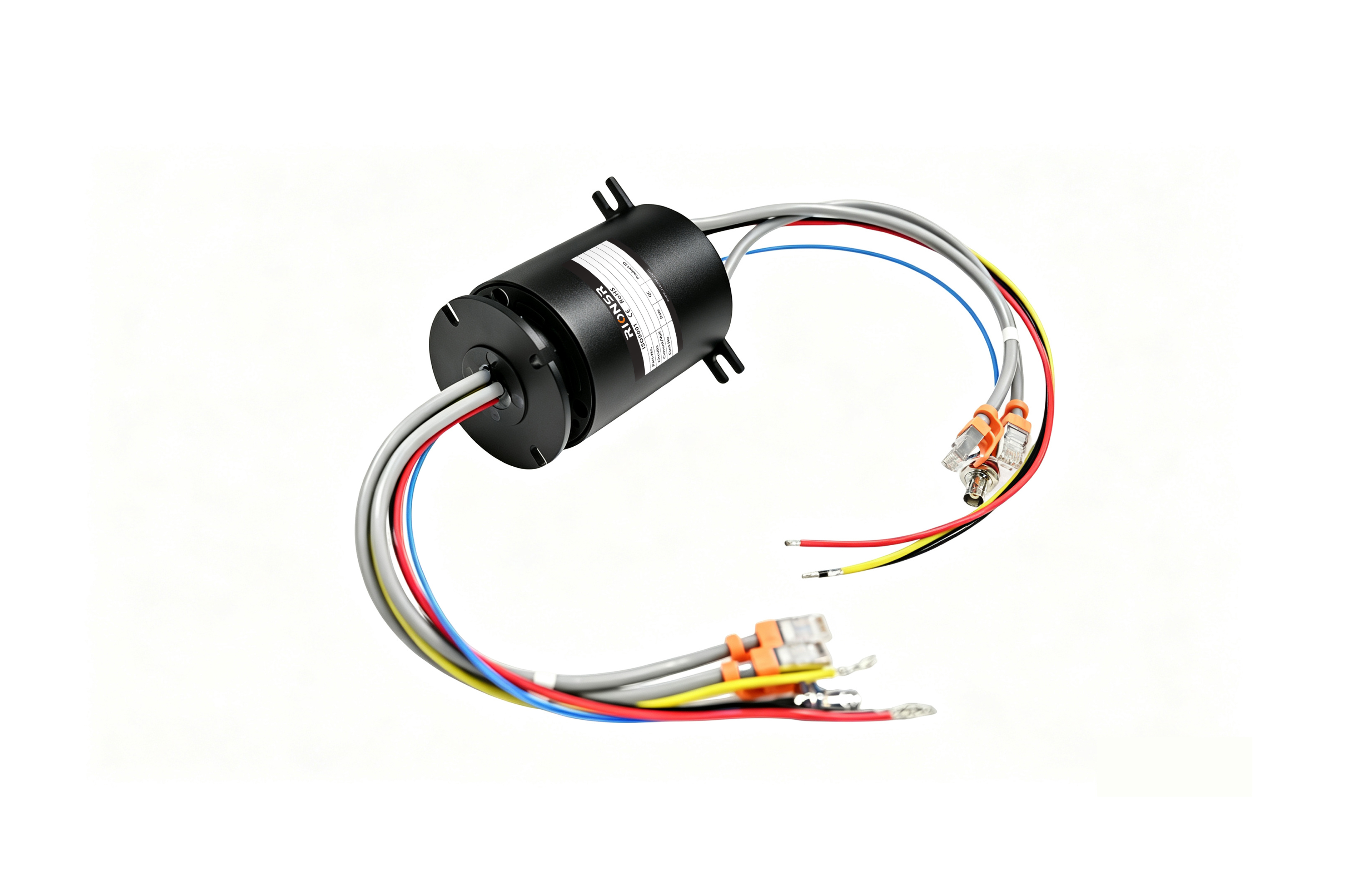
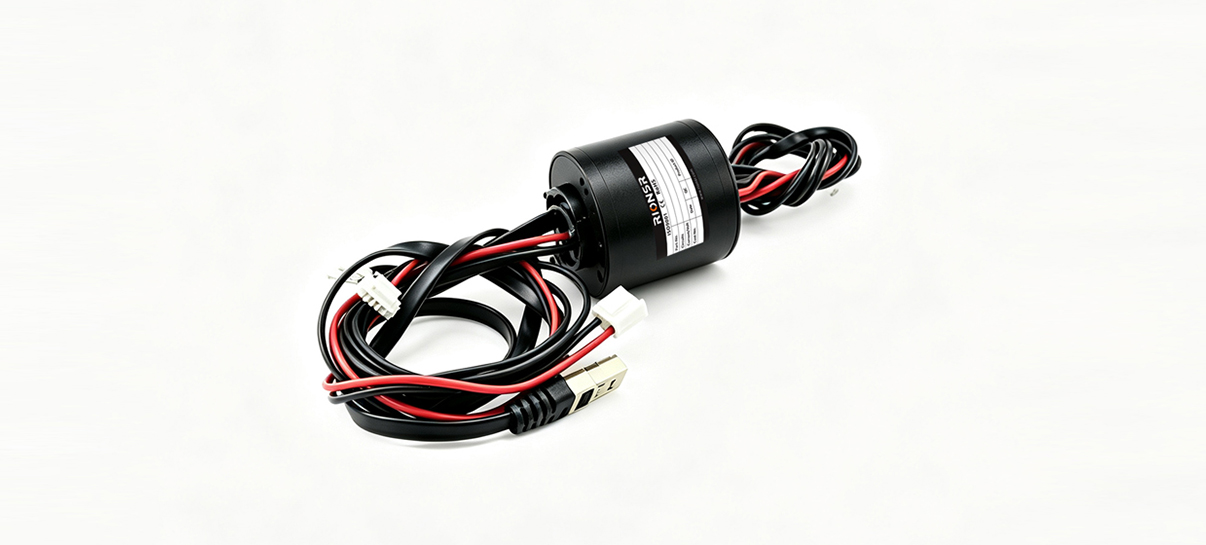
1 Definition of Capsule Slip Rings
Ethernet slip rings (network slip rings / RJ45 slip rings) are high-speed data rotary connectors engineered for rotating machinery, delivering stable transmission of 10/100/1000BASE-T industrial Ethernet, Profinet, EtherCAT and other fieldbus protocols during unlimited 360° continuous rotation. Standard general slip rings suffer severe packet loss, latency and crosstalk when transmitting network signals. Ethernet slip rings adopt shielded precious metal rings and differential impedance matching structures to maintain lossless real-time gigabit communication, while supporting simultaneous mixed transmission of power and digital IO signals. They are widely deployed in automated production lines, wind power equipment and machine vision inspection systems.
2 Specialized Internal Structural Optimizations for High-Frequency Network Signals
Compared with generic conductive slip rings, Ethernet slip rings feature three exclusive design upgrades for high-frequency data:
- Paired differential precious metal tracks: Separate gold-plated rings for transmit/receive wire pairs, precisely matched to 100Ω differential impedance to eliminate signal reflection and return loss.
- Full EMC shielding enclosures: Integrated copper foil shielding cavities inside stator and rotor to block electromagnetic interference from high-power power circuits, preventing network disconnection.
- Low-dielectric insulating media: Special polymer insulation with low permittivity reduces high-frequency signal attenuation, compliant with CAT5E / CAT6 industrial cable standards. Three form factors are available: capsule Ethernet slip rings, through-bore Ethernet slip rings and pancake Ethernet slip rings for diverse installation space constraints.
3.Core Performance Specifications for Reference During Selection
- Supported protocols: 100M/1000M Ethernet, EtherCAT, Profinet, CAN FD.
- Critical electrical metrics: Insertion loss ≤0.8dB, return loss ≥18dB, near-end crosstalk <-22dB.
- Hybrid circuit combinations: Single gigabit Ethernet channel paired with 3~60 power/digital IO channels for customizable layouts.
- Transmission range: Matches standard industrial Ethernet cables with zero additional signal attenuation.
- Service life: Gold-on-gold contacts support 8 million rotations without packet loss.
4 Industrial Application Scenarios
- Automated rotary tooling & robotic joints: Real-time EtherCAT bus transmission to upload machine vision inspection data during robotic arm rotation.
- Wind turbine generators: Gigabit Ethernet data transmission between nacelle and rotating hub for real-time upload of rotational speed, temperature and fault diagnostics.
- 360° machine vision inspection turrets: Latency-free 4K image data transmission from rotating industrial cameras.
- Intelligent panoramic surveillance pan-tilts & vehicle radar turrets: Gigabit network delivery of 4K high-definition monitoring video.
- Logistics sorting rotary tables, intelligent warehouse rotary stacking mechanisms.
5 Selection Checklist to Avoid 4 Common OEM Mistakes
- Using generic slip rings for Ethernet transmission: Generic units lack impedance matching, causing frequent gigabit network stalling and disconnection. Dedicated Ethernet slip rings are mandatory.
- Adjacent placement of power circuits and Ethernet tracks: High-current power loops generate EMI triggering packet loss; specify additional shielding isolation between network and power channels during customization.
- Ignoring rotational speed impact on signal integrity: Select high-speed dedicated Ethernet slip rings for operation above 300RPM to eliminate impedance fluctuation from contact friction.
- Confusing 100M and gigabit variants: Gigabit Ethernet slip rings are required for 4K vision and real-time fieldbus; 100M models only suit low-speed basic monitoring signals.
6 Installation & Wiring Standards to Stabilize Network Performance
- Separate cable routing: Maintain ≥5cm spacing between Ethernet cables and power cords, avoid bundling or twisting together.
- RJ45 connector protection: Install waterproof jackets on rotary-side Ethernet connectors; select sealed aviation plug variants for humid workshop environments.
- Rotational cable slack allowance: Reserve sufficient loose length for rotor wiring to eliminate tension or tight bending during rotation.
- Reliable grounding: Earth slip ring housing fully to dissipate electromagnetic noise and reduce network interference.
- Commissioning workflow: Run 2-hour no-load rotation, conduct continuous ping tests to verify zero packet loss before mass production deployment.
7 Troubleshooting Long-Term Signal Attenuation Failures
- Network stalling & mass packet loss: Damaged shielding layers or oxidized contacts. Solution: Replace Ethernet slip rings with reinforced shielding; perform low-pressure air dust cleaning on sealed units only.
- Weak signal over long transmission distances: Upgrade to CAT6-rated Ethernet slip rings for reduced insertion loss.
- Insufficient bus real-time performance & servo alarms: Mismatched differential impedance; replace with factory-matched gigabit Ethernet variants.